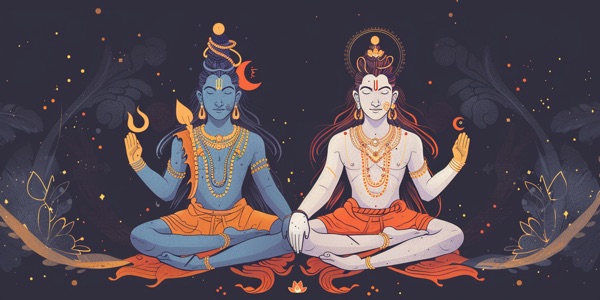
The old sage sat beneath the banyan tree, his white beard flowing like the river behind him. A young traveler approached, dust covering his feet from the long journey. Bowing respectfully, he asked, “Master, I have heard many stories of your gods — of Shiva, the destroyer, and Rama, the perfect king. But I do not understand. How can destruction be divine? And why must a god, like Rama, suffer in exile”?
The sage smiled. “Ah, my child, to understand the gods, one must look beyond what the eyes see. Sit, and I will tell you a story”.
The Dance of Shiva: Destruction and Creation
“Long ago”, the sage began, “when the world had lost its balance, the gods turned to Shiva. With matted hair and a serpent around his neck, he sat deep in meditation. His stillness held the universe together. But when the world grew corrupt, when darkness spread too far, Shiva rose.
With a single step, he began to dance — the Tandava, the cosmic dance of destruction. Mountains crumbled, rivers changed course, and time itself trembled. But, my child, do you know what happened next”?
The traveler shook his head.
“When Shiva dances”, the sage continued, “he does not destroy for the sake of destruction. He clears the path for new beginnings. Like a storm that makes way for fresh green shoots, he removes what is no longer needed. That is why he is not just the destroyer — he is the transformer”.
The traveler frowned. “But isn't destruction painful”?
“It is”, the sage agreed. “But sometimes, pain is the price of growth. A snake sheds its skin. A fire burns the old to make room for the new. The wise do not fear endings, for they know that within every end is a new beginning”.
Rama's Exile: Duty Above All
The traveler sat in thought. “And what of Rama”? he asked. “Why must a god suffer”?
“Ah”, the sage said, “Rama's story is the greatest lesson of all. He was the ideal king, wise and just. But on the day of his coronation, fate turned against him. His father, bound by an old promise, sent him into exile for fourteen years. He lost his throne, his home, and later, even his wife. But do you know what he did”?
The traveler hesitated. “He accepted it”?
The sage nodded. “Yes. Rama could have fought, but he did not. He placed dharma — his duty — above his desires. He walked through forests, faced demons, and suffered great loss, but he never wavered. He remained righteous, even when the world was unfair”.
The traveler's eyes darkened. “But why? Why not fight against injustice”?
The sage's voice was gentle. “Because true strength is not in winning battles. It is in staying true to what is right, even when the path is hard. Rama's story teaches us that honor and duty matter more than personal gain. A real leader does not rule for himself, but for others”.
The Eternal Truth
The traveler sat in silence. He looked at the earth beneath him, at the river flowing past, at the endless sky above. He understood now.
Shiva's dance was not about destruction — it was about change. Rama's suffering was not about weakness — it was about duty. The gods did not exist to make life easy. They existed to teach, to guide, to remind humanity that all things — good and bad, joy and sorrow — are part of a greater balance.
The sage placed a hand on the traveler's shoulder. “Now tell me, child. When you face hardship, when life takes something from you, will you weep for what is lost? Or will you, like Shiva, embrace the dance? Will you, like Rama, walk your path with honor”?
The traveler smiled.
 Lingard

 The Universe's Prime Number: The Mystery of Alpha and the Blueprint of Reality
 100 Daily Practices from a Japanese Zen Monk for a Lifetime of Calm and Joy
 Shamanic Keys to Reclaim Your Personal Power, Transform Yourself, and Light Up the World
 Explore the Boundaries of Freedom and Liberty's True Essence
 In Search of the Sacred in Modern India
 Princess Mononoke
 A Voyage to Arcturus
 Mark Zuckerberg on Building the Future of Connection
 Lewis Hamilton on Redefining Success
 Three Items on a Deserted Island
 Philosophical Discussions on the Meaning of Life
 Bill Gates on Rethinking Success