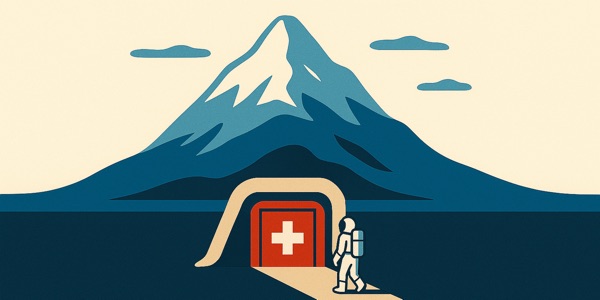
A Dream Beneath the Alps
Deep inside a Swiss mountain, a group of students spent their summer living like astronauts. Their goal: to discover what life on a lunar base might really feel like. The project, called Asclepios, is the world's first and biggest international student-led space simulation. Every year, it recreates a mission that tests human endurance, teamwork, and innovation in extreme conditions.
For Katie Mulry, a 24-year-old aerospace engineering student from the U.S., this project is more than a dream come true. “When I first thought about becoming an astronaut, I didn't know where to start”, she says. “Now, I'm helping organize missions that bring us one step closer to real space exploration”.
This summer, nine students from around the world isolated themselves for more than two weeks inside the old Gotthard military fortress, buried under the Swiss Alps. Hidden among tunnels stretching over 3.5 km, the base stays at a constant temperature of 6°C — the perfect place to simulate the cold darkness of the Moon.
Building a Base Beyond Earth
The Asclepios team designed their base to resemble a lunar lava tunnel, a type of cave scientists believe could protect astronauts from radiation on the Moon. During the mission, students only left the base at night to test how the absence of sunlight affects their sleep, mood, and energy.
“It's about understanding the challenges humans face in space”, says Mulry. “If we can study them here on Earth, we can prepare astronauts better for real missions”.
Participants trained for months before the simulation. They practiced survival techniques in freezing conditions, learned about space psychology, and even joined zero-gravity flights. The experience is completely free — funded by donations and sponsorships — making it accessible to students who dream of working in the space industry.
Life Inside the Lunar Base
Inside the “Moon base”, conditions are simple and strict. The nine crew members share one bathroom, eat real dehydrated astronaut food, and perform science experiments every day. When they “go outside”, they wear full spacesuits and walk through the dark tunnels of the fortress, imitating Moon walks on the rocky surface.
Mateus Magalhaes, a 27-year-old Brazilian PhD student, acted as the commander during the two-week mission. His job was to make final decisions and lead the team. “Most Moon or Mars simulations are very expensive”, he says. “Asclepios gives students the chance to live this experience for free and learn from it”.
The Science of Sleep and Space
One of the main experiments this year focused on circadian rhythms — the body's internal clock that regulates sleep and wakefulness. Researchers from Spain, Australia, and Switzerland worked with the students to study how constant darkness changes hormone levels and body temperature. The data collected will be used to improve astronaut health and also to help people on Earth — such as night-shift workers and travelers who suffer from jet lag.
“This collaboration between students and scientists shows how education and research can work together”, says Maria Comas Soberats, a chronobiology expert involved in the project.
Training the Next Generation
For many participants, Asclepios is a life-changing experience. Matthew Acevski, a 23-year-old researcher from Imperial College London, calls it “one of the best experiences” of his life. “I've studied space physics for years, but this mission gave me real hands-on training. It made me realize I want to focus on human spaceflight”.
Another participant, Lauren Victoria Paulson, a 22-year-old aerospace engineering PhD student from Georgia Tech, worked as the base engineer. She believes what they learn from space can help people survive extreme conditions on Earth. “Designing for space means designing for efficiency”, she says. “The technologies we create can later be used to recycle water, grow food, and adapt to climate change”.
Beyond the Mountain
When the mission ended, the students emerged from the tunnels into the daylight — tired but inspired. For them, this experience was not just a simulation; it was a glimpse of the future. The dark slopes of the Swiss Alps might one day be remembered as the training ground for the next generation of lunar explorers.
“Every time you push your comfort zone”, says Paulson, “you become a little more like an astronaut — and a stronger human being”.
 Lingard
 Your IELTS Game Plan
 Repeat to remember: how re-reading boosts fluency
 The Universe's Prime Number: The Mystery of Alpha and the Blueprint of Reality
 How Long Can You Stay Awake? Exploring the Limits of the Human Body
 A Brief History of Humankind
 The Universe Beyond Our Galaxy: Uncovering Exoplanets and Cosmic Phenomena
 Evolution of Medicine: From Traditional Methods to Modern Discoveries
 Exploring Outer Space: Current Missions and Future Prospects
 Breakthroughs in Nanotechnology: A Revolution in Science on a Microscopic Scale
 Cutting Down on Coffee? Why Your Dreams May Feel Stronger
 The surprising foods that lead to better sleep
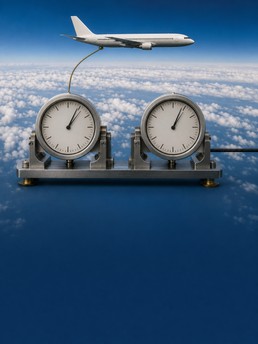 Why you age slower on a plane