
"Squid Game", the South Korean Netflix series, quickly became a global phenomenon. Its gripping story and striking visuals captivated audiences worldwide. Here are some of the most fascinating facts about the series:
1. A Decade in the Making
Director Hwang Dong-hyuk first wrote the script for Squid Game in 2008. At the time, he was heavily in debt, much like the show's contestants. Many production companies rejected the project, calling it too violent, dark, and unlikely to succeed. Without sufficient funding or support, Hwang shelved the idea for over ten years. It wasn't until 2019, when Netflix announced its interest in global content, that the series was revived. Originally titled Round 6, the project gained momentum, eventually transforming into the cultural milestone we know today.
2. Inspired by Childhood Games
The concept of Squid Game revolves around traditional children's games that were popular in South Korea during the 1970s and 1980s. The titular game was one the director himself played as a child. By incorporating these seemingly innocent games into life-and-death scenarios, Hwang created a sharp contrast between nostalgia and the brutal realities of survival in a hyper-competitive society. This contrast amplifies the show's emotional and psychological impact on viewers.
3. Design and Symbolism
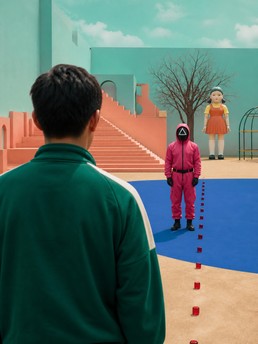
The series is visually distinctive, with its use of vibrant colors and geometric symbols. The participants wear green tracksuits, reminiscent of uniforms worn by Korean students in the past, while the guards wear hot pink uniforms and masks featuring shapes like circles, triangles, and squares. The stark color contrast visually separates the oppressed players from the enforcers. The guards' masks and uniforms erase individuality, symbolizing the dehumanizing effects of strict hierarchies. The shapes on the masks denote roles: circles for workers, triangles for soldiers, and squares for managers. This system mimics an ant colony, where roles are rigidly assigned.
4. Hidden Clues About Player 001
From the very first episode, subtle hints were sprinkled throughout the series, foreshadowing the reveal about Player 001, Oh Il-nam. His player number, 001, hinted at his position as the "first" and most powerful participant. During the "Red Light, Green Light" game, the animatronic doll never detected him, allowing him to remain safe. His choice of a simple star shape in the honeycomb game also underscored how he avoided danger. Even during the dormitory fight, his plea to stop the violence led to immediate intervention by the guards, a level of influence no other player held.
5. Global Impact
Squid Game shattered records, becoming Netflix's most-watched series just days after its release. It overtook popular titles like Money Heist and Sex Education, drawing viewers from over 90 countries. Beyond its entertainment value, the series sparked conversations about greed, class disparity, and the moral dilemmas of survival. Fans worldwide eagerly await the next season, with the director teasing the potential for new stories in the Squid Game universe. The show's success also propelled its cast to global stardom, with many becoming social media sensations overnight.
 Lingard
 Green Book: What the Film Teaches Us
 The Devil Wears Prada: What the Film Teaches Us
 The Secrets of Oppenheimer: What the Film Really Tells Us
 The Secrets of Tenet: What the Film Really Tells Us
 Fascinating Facts About the Barbie Movie
 Breaking Bad: Surprising Facts You May Not Know
 The Hunger Games: Interesting Facts You Didn't Know About the Movies
 Harry Potter: The Most Interesting Facts You Didn't Know
 Shrek: Fun Facts You Didn't Know
 Stranger Things: Surprising Facts About the Show
 The Secrets of Emily in Paris: What the Show Really Tells Us
 Fun Facts About the Madagascar Movies