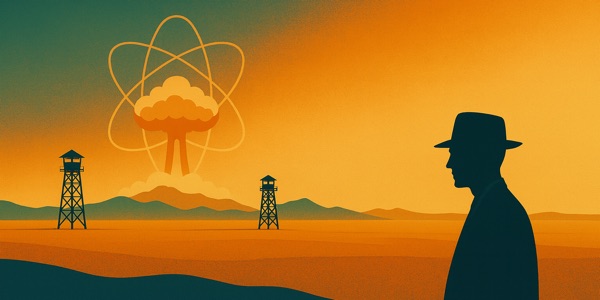
Introduction
Oppenheimer by Christopher Nolan is not just a historical film. On the surface, it tells the life of J. Robert Oppenheimer, the brilliant physicist who led the Manhattan Project and helped create the atomic bomb. But behind this story lies something larger. The film is about ambition, fear, morality, and the weight of human decisions.
Nolan builds the movie like a puzzle. We move between memories, hearings, and visions. We see Oppenheimer both as a young dreamer and as a man destroyed by his own creation. This structure makes the film more than a biography. It becomes a reflection on science and power, on progress and guilt, on what it means to change the world forever.
Science and Power
In the beginning, Oppenheimer sees science as beauty. He studies physics with excitement and curiosity. For him, particles and stars are not just numbers — they are doors to understanding the universe. His visions of waves, sparks, and explosions show that for him, science is almost like poetry.
But science does not exist outside of history. When World War II begins, knowledge becomes a weapon. The Manhattan Project turns theory into practice. Dozens of the greatest scientists gather at Los Alamos, building a city of secrets. Oppenheimer is their leader, and he feels the power of turning imagination into reality.
The film shows the danger of this transformation. What begins as discovery becomes destruction. Knowledge gives humanity the ability to create, but also the power to kill on an unimaginable scale. Nolan asks us to think: can science be separated from its use, or does every discovery carry responsibility for what follows?
The Burden of Responsibility
For Oppenheimer, the bomb is not only a project. It is a burden he carries. He tells himself that the bomb must be built before Nazi Germany can do it. This fear drives him forward. He believes he is protecting the world. But when Germany surrenders, and the bomb is still completed, the question changes: is it protection, or is it power?
After Hiroshima and Nagasaki, the weight of responsibility becomes unbearable. Thousands of civilians are dead. The war is over, but the guilt begins. Nolan shows this in the scene of Oppenheimer giving a victory speech. The crowd cheers, but in his eyes he sees burned bodies and hears screams. Triumph and horror live together in his mind.
From this moment, Oppenheimer cannot escape the truth. He is called “the father of the atomic bomb”, but for him this is not honor. It is a curse. His face shows pride, but his heart carries guilt. This contradiction becomes the center of his life.
Politics and Betrayal
The film also shows how politics can destroy even the greatest minds. After the war, Oppenheimer speaks against the hydrogen bomb. He argues that the arms race will only bring more danger. But his words are seen as weakness, even as betrayal.
Lewis Strauss, a powerful figure in Washington, uses this moment to attack him. Through secret hearings, Strauss organizes Oppenheimer's fall. The hearings look like justice, but they are a tool of fear and revenge. Testimonies are twisted, private life is exposed, and old friendships are broken.
In the end, Oppenheimer is stripped of his security clearance. The man who gave his country the most powerful weapon is treated like a traitor. Nolan shows this as a deep irony: a hero of war turned into an enemy by politics. It is a lesson about how quickly society can betray its own creators once they no longer serve its goals.
Personal Life and Inner Conflict
The movie also focuses on Oppenheimer as a man, not only as a scientist. His private life is full of conflict. His marriage to Kitty is troubled, with moments of passion but also of anger and distance. His love for Jean Tatlock is intense, but it brings him sadness and guilt. He is brilliant in physics but often weak in relationships.
These struggles reflect his larger conflict. Just as he cannot control his heart, he cannot control the weapon he creates. His private mistakes and his public actions mirror each other. Both show a man who wants to lead but who fears the results of his leadership.
Oppenheimer's inner world is full of contradictions. He wants recognition as a genius, but when recognition comes, it feels poisoned. He dreams of discovery, but his discoveries bring destruction. This makes him a tragic figure: a man who changes history but cannot control the meaning of that change.
Symbolism and Imagery
Nolan fills the film with images that show Oppenheimer's thoughts. Sparks, waves, and stars appear in his mind. These are not only science — they are symbols of creation and destruction. The same fire that inspires him to study physics is the fire that can burn the world.
The Trinity test is the center of the film. In the desert, scientists and soldiers wait in silence. When the bomb explodes, the screen goes quiet before the sound arrives. The silence makes us feel both wonder and fear. It is the moment when science becomes power, when history enters a new age.
From that point, there is no return. Humanity has stepped into the nuclear age. The bomb is not just a weapon; it is a line that divides history into “before” and “after”.
The Ending and Its Meaning
At the end of the film, Oppenheimer meets Albert Einstein. He tells him his deepest fear: that the bomb might not just kill enemies, but could one day destroy the whole world. Einstein listens and walks away, leaving Oppenheimer alone with his thoughts.
This moment connects science with morality. It shows that the bomb is not only a weapon of war but also a question for the future: can humanity control the power it has created? Nolan ends the film not with answers but with a warning.
The final vision is of fire spreading across the Earth. It is Oppenheimer's nightmare, but it is also a real possibility. The film closes with uncertainty. The age that began with Trinity might end with global destruction.
Conclusion
Oppenheimer is not just a film about history or about one man's life. It is a reflection on human ambition and the price of progress. It shows how a dream of discovery can turn into a weapon of fear, and how the mind that changes the world can also destroy itself.
The film reminds us that science is never separate from morality. Knowledge carries responsibility. The same physics that explain the stars can also create bombs. Oppenheimer's story is a mirror for humanity itself. We have the power to shape the future, but the real question is: do we have the wisdom to use that power?
 Lingard
 Green Book: What the Film Teaches Us
 The Devil Wears Prada: What the Film Teaches Us
 The Secrets of Tenet: What the Film Really Tells Us
 Fascinating Facts About the Barbie Movie
 Surprising Facts About Squid Game
 Breaking Bad: Surprising Facts You May Not Know
 The Hunger Games: Interesting Facts You Didn't Know About the Movies
 Harry Potter: The Most Interesting Facts You Didn't Know
 Shrek: Fun Facts You Didn't Know
 Stranger Things: Surprising Facts About the Show
 The Secrets of Emily in Paris: What the Show Really Tells Us
 Fun Facts About the Madagascar Movies