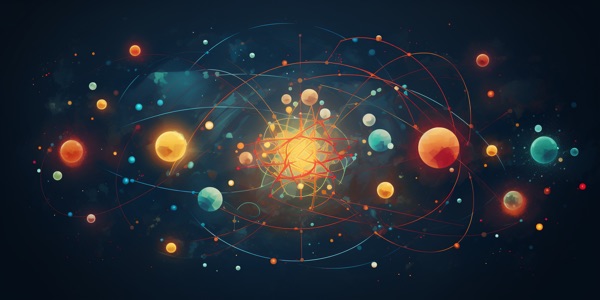
Quantum mechanics, a branch of physics that explores the behavior of particles at the subatomic level, challenges our conventional understanding of the universe. This article offers an introductory overview of the fascinating world of quantum mechanics, shedding light on its fundamental concepts and implications.
1. The Quantum Revolution
Quantum mechanics emerged in the early 20th century as a response to the limitations of classical physics. It introduced a new way of understanding the behavior of particles that are unimaginably small, such as electrons, protons, and photons.
2. Wave-Particle Duality

One of the central principles of quantum mechanics is the concept of wave-particle duality. Subatomic particles, such as electrons, can exhibit both particle-like and wave-like properties simultaneously, challenging our everyday intuition.
3. The Uncertainty Principle

Werner Heisenberg's uncertainty principle is a cornerstone of quantum mechanics. It states that the more accurately we know a particle's position, the less accurately we can know its momentum, and vice versa. This principle highlights the inherent limitations of our ability to measure subatomic particles.
4. Superposition and Entanglement

Quantum mechanics introduces the intriguing phenomena of superposition and entanglement. Superposition allows particles to exist in multiple states simultaneously until they are observed. Entanglement occurs when particles become connected in such a way that the state of one particle directly influences the state of another, regardless of distance.
5. Quantum Mechanics in Everyday Life

Although quantum mechanics may seem abstract, its principles have practical applications. Devices such as lasers, semiconductors, and medical imaging technologies rely on quantum mechanics to function. Quantum computing, an emerging field, has the potential to revolutionize computing power and solve complex problems more efficiently.
6. The Role of Quantum Mechanics in Cosmology

Quantum mechanics also plays a role in our understanding of the cosmos. It is essential for explaining the behavior of particles during the early moments of the universe's existence, as well as the properties of black holes.
 Lingard

 Cutting Down on Coffee? Why Your Dreams May Feel Stronger
 The surprising foods that lead to better sleep
 How noise sensitivity disrupts the mind, brain and body
 Sourdough vs White Bread: What Should We Be Eating?
 What Poison to Take to Survive?
 The Mysteries of the Earth and Space: Exploring the Unknown
 The Art and Science of Creating Good Luck
 The Human Microbiome: Unveiling the Microscopic Ecosystem Within Us
 Artificial Intelligence and Ethics: Overcoming the Boundaries of AI Development
 Genes and Heredity: How Science Deciphers Our Genetic Codes
 4 Latest Innovations in Tech
 How to Keep Your Brain Healthy