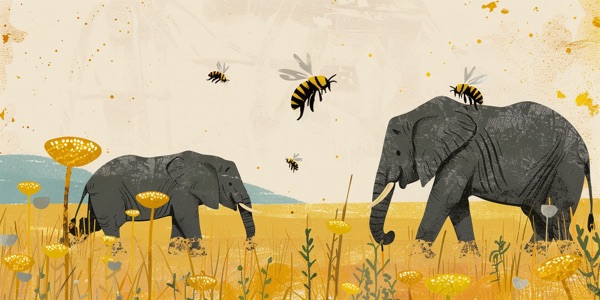
As human populations expand, agricultural development increasingly encroaches into elephant habitats. This unfortunate overlap often results in dangerous confrontations as elephants trample — sometimes completely destroy — farmers' crops. In Kenya, though, decades of trial and error have led to a solution as simple as it is brilliant: beehive fences. These buzzing borders are already redefining coexistence in parts of Africa, Asia, and beyond.
Farming on the frontline of conflict
The rise in recent years of human-elephant conflict is rooted in the shrinking and fragmentation of elephant ranges. Agricultural expansion, logging, urban growth, and land division force elephants into ever closer contact with subsistence farmers. For many families, losing a season's harvest can be catastrophic. As one farmer from Mwakoma, Kenya, lamented, “If elephants come when the crops are nearly mature, everything can vanish in one night”.
These encounters are not just inconvenient; they are often tragic. Farmers may be killed while trying to defend their fields, and elephants are frequently harmed or even hunted in retaliation. This cycle of fear and violence creates lasting trauma in rural communities and damages conservation efforts. For those living on the margins, the pressure to protect their land often outweighs concern for endangered species.
The buzz about bees — and elephants
The idea that bees could deter elephants might sound improbable, but it is grounded in observation and science. The story begins with a curious piece of folklore: trees with beehives, local herders claimed, were left alone by elephants. Ecologists like Fritz Vollrath and Lucy King investigated the claim and discovered an astonishing truth. Not only do elephants avoid trees with beehives, but they also communicate this risk to other elephants through low-frequency rumbles — a sort of warning signal to stay away.
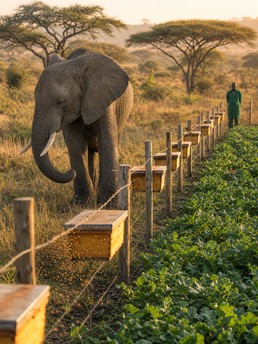
This insight inspired the creation of "beehive fences": strings of hives hung between posts surrounding farms. As an elephant approaches, it may disturb a hive and get stung — particularly around the sensitive areas of the eyes and trunk. The discomfort is memorable, and elephants, known for their exceptional memory, quickly learn to avoid such areas. The visual deterrent is enhanced with dummy hives, which trick the elephants into overestimating the number of bees present.
Harvesting hope — and honey
The benefits of this approach extend far beyond elephant deterrence. Beehive fences empower communities to reclaim their land, reduce nighttime anxiety, and increase their economic resilience. Farmers who once feared losing their only source of food now also harvest honey — an additional stream of income that supports education, healthcare, and stability.
For women, especially, the impact is significant. In many villages, women tend to the crops and bear the burden of managing conflict with wildlife. The introduction of beehive fences reduces their exposure to danger and opens the door to new opportunities. Some women have even trained as beekeepers and community educators, strengthening their social roles and contributing to long-term sustainability.
Caveats of climate and complexity
No solution comes without limitations. Climate change poses a real threat to the success of beehive fences. Droughts diminish floral resources, causing bee colonies to collapse. Heavy rains can wash away flowering plants, reducing nectar supplies. During such periods, the effectiveness of the fences drops, and the risk of conflict increases.
This is why beehive fences must be part of a broader, multi-layered strategy. Supplemental tools — like chili briquettes, watchtowers, or motion-activated lights — can increase protection. But at the core, long-term solutions must involve land-use planning, habitat conservation, and policies that support coexistence between humans and elephants.
Coexistence is possible — with intention
From humble beginnings with just two fences, the initiative has blossomed. Today, hundreds of beehives protect fields across multiple villages, dramatically reducing crop loss and restoring a sense of peace. In these communities, attitudes toward elephants have shifted. Where once there was fear, there is now cautious respect — and even hope.
This story is a reminder of what happens when science listens to tradition, and when people are empowered to defend their homes not with violence, but with creativity. Beehive fences won't solve every problem, but they illuminate a path forward. In a world grappling with ecological crisis, these buzzing lines between man and beast hum with the possibility of harmony.
In rural Africa, elephants and farmers have long clashed over land and crops — with devastating consequences on both sides. But a surprising solution is turning conflict into coexistence: beehive fences. Why do elephants fear bees, and how is this helping Kenyan communities protect their food, their safety, and even earn extra income? What started as folklore is now backed by science — and reshaping the future of human-wildlife relationships. Discover how honeybees became unlikely heroes in the battle to farm in peace.
 Lingard
 Mud, water and wood: The system that kept a 1604-year-old city afloat
 Why you age slower on a plane
 Should we all be taking vitamin supplements?
 What body odour reveals about your health
 The school for astronauts hidden inside a Swiss mountain
 The Universe's Prime Number: The Mystery of Alpha and the Blueprint of Reality
 How Long Can You Stay Awake? Exploring the Limits of the Human Body
 Brave work. Tough conversations. Whole hearts.
 A Brief History of Humankind
 The Universe Beyond Our Galaxy: Uncovering Exoplanets and Cosmic Phenomena
 Evolution of Medicine: From Traditional Methods to Modern Discoveries
 Desert Landscapes: Understanding Unique Ecology and Adaptations